
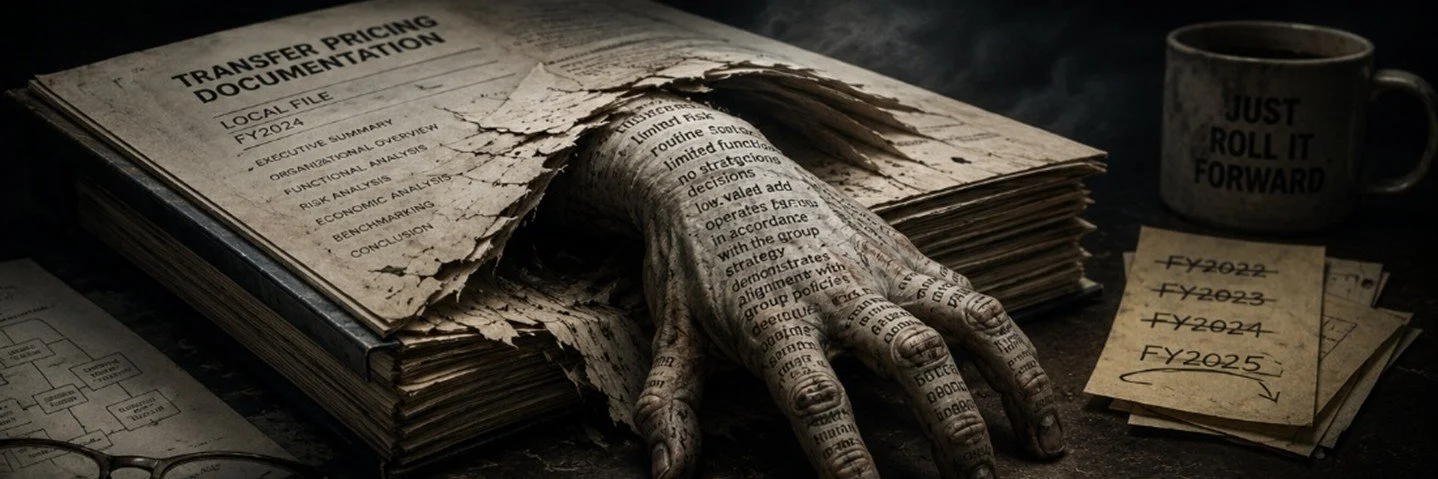
In the spirit of Halloween, and with yet another year of documentation now freshly in the rearview mirror, it’s a good time to talk about one of the scariest things one regularly comes across in transfer pricing: Zombies!
** ** ** ** **
Imagine the setting.
Another year has passed, and it’s time to update your company’s transfer pricing documentation. Reflexively, you reach back into the archives for last year’s report. A simple roll-forward seems easiest for a business with no big policy or business changes in the books.
It should be straightforward.

You expect to find a full body of knowledge there. A healthy record of the business as it existed a year ago, who did what, and where important decisions were made. What risks were being managed, and by whom. How intercompany arrangements enabled vital flows. As far as you know, it’s all the “Same As Last Year,” so this year will be a simple task.
With optimism, you reach into the digital void.
You sense something reaching back.
A cold hand that firmly grasps you!
What emerges from the archive looks like full-bodied transfer pricing documentation. It’s labeled FINAL. It has heft. There is a confidence-inducing logo emblazoned on the cover. A skim reveals a verbose functional analysis: Functions have been defined, and the assets and risks assigned. A method selected. The economic analysis has benchmark tables and a bold arm’s-length conclusion.
All the outward appearances of a normal report. But…
…you sense something is off.
The thing you behold is only a facsimile of a living, breathing record of the controlled transactions. Its vacant eyes reveal little about how the enterprise actually operates. Its misshapen bones have been assembled from standardized descriptions, knit together by the stubborn sinews of inherited representations and facts carried forward from prior years. Some of its vital organs are missing, leaving gaping holes sometimes purported to reside elsewhere, in schedules and source materials said to be “maintained by the Company.” Its economic analysis may establish what the policy was intended to produce, without ever checking for the pulse of what actually happened. And shuffling at its slow, compromised pace, it can scarcely keep up with the natural speed of modern commercial operations.
A wave of momentary dread ensues. You stammer a challenge, “How did this happen?” After all, Firm X signed off on the deliverable. “What did they do?”
The moaned response is chilling,
“SAAAA-LYYYY...”
You have found Zombie Documentation!
[Cue cries of terror and alarm from the unsuspecting Tax Team.]
And the consequences are infectious!
Susceptible Hosts
Like a busload of Hollywood extras, Zombie Documentation comes in all shapes and sizes. It isn’t necessarily short, nor is it necessarily cheap. A concise, well-supported report can be considerably more useful than a hundred-page tome dominated by anodyne boilerplate.

Producing zombies was (hopefully!) never the intent. The main risk factors tend to be the familiar pressures of time and money: too little of both. It is not a hot take that transfer pricing documentation has become an increasingly demanding exercise, with more jurisdictions, more variations, and more unique annual compliance obligations, collectively straining against the limits of finite tax department budgets and available time. Even tax teams with a strong in-house transfer pricing group are seldom able to commission regular operational discovery, particularly when the business and its transfer pricing policies are understood to have persisted, largely unchanged.
Naturally, the market has responded with cost-sensitive solutions. It’s old news that documentation work is often routed through centralized production teams, generally far removed from the professionals most well-acquainted with their client’s facts. Functional interviews give way to simplified ‘year-over-year change’ questionnaires, existing reports become boilerplate templates for new ones, and sophisticated-looking software (once mostly the province of Big 4, now also joined by a growing crowd of enticing AI-enabled tools) can repackage prior-year analyses with impressive efficiency, or at least with impressive fee quotes. (But let’s defer deeper thoughts about the role of AI in documentation for a forthcoming Margin Note.)
None of these responses to the economics of documentation is inherently problematic. But as the process streamlines, it tends to strip out the experienced scrutiny that recognizes when the story no longer rings true. Many key details in transfer pricing reports (i.e., risks managed, by whom, and what changed) are not found in a trial balance, or in an agreement, or in the resulting invoices. They live in a data ‘No Man’s Land’ outside the ERP, where finding them requires an experienced practitioner asking the right people the right questions. This unseen gap offers a dark space for zombies to exist and fester.
Patient Zero or Patient Minus N?
Sometimes the infection predates even the first annual update. Templates are indispensable to efficient professional work, and there is nothing objectionable about borrowing a sound analytical framework. But danger arises when the template begins supplying the factual narrative rather than merely organizing facts established through investigation. The danger is that familiar transaction types (e.g., limited risk distribution and services, etc.) share a common functional and risk fact pattern.
The resulting language can be deceptively difficult to challenge. Generalized descriptions of routine functions, application of strategic oversight, and risks assumed under intercompany agreements may sound entirely plausible, particularly to an internal reviewer who knows the business well, but lacks a specialist’s awareness to detect ambiguous, baseline functional vernacular for what it is; or has pressing deadlines that compress allotted review time. Such language rarely contains enough specificity to expose an obvious contradiction, yet it often leaves unanswered salient details about actual decision-making, commercial responsibilities, control of risks, and the actions of identifiable personnel who actually exercise those responsibilities.
On the other hand, this language is exceptionally easy to update. With few concrete assertions to reconsider, each new year requires little more than confirmation that nothing material has changed, followed by refreshed financial data and a revised date on the cover. For anyone tasked with producing a slew of update reports on a tight budget, this is a very attractive format!
But the result can be a particularly resilient strain of Zombie Documentation—one that may never have possessed much of a pulse in the first place.
The Infection Spreads
Unfortunately, Zombie contagion is hard to confine. Transfer pricing documentation naturally becomes foundational to a company’s institutional memory. It serves as the starting point for agreements, audit responses, company representations, and of course, future reports. New advisers adopt the legacy narrative, and labor to ‘prove’ it out in annual updates. Thus, a characterization introduced years ago with limited scrutiny may be repeated virtually unchanged, creating multiple years of “reassuringly consistent and quick-to-review” update documentation that actually rests on a series of untested propositions.
The Circularity of Zombie Documentation:
An ironic circumstance in which a consultant supports the policies and assumptions supplied by the company, while company personnel defer to the policies and conclusions endorsed by the consultant. Each believes the other has supplied the necessary judgment. Neither recognizes that both may simply be perpetuating the same inherited assumptions.
Meanwhile, the business itself evolves, gradually gnawing away at the foundational facts and circumstances. Responsibilities migrate between entities, key managers relocate or assume new roles, operations develop and commercial risks shift, often without corresponding changes to formal policies. Yet Zombie Documentation can survive these developments because even consequential changes may appear to fit comfortably (enough) under the umbrella of a broad, inherited business description.
Once the tradition of justifying the legacy language takes root, it is a hard habit to break.
This is where Zombie Documentation becomes genuinely infectious. Each time such zombies sink their teeth into another document, the original assertions they proliferate acquire an appearance of even greater authority, making them far less likely to be questioned. The zombie’s bite is truly infectious, and each new zombie creates yet more toothy vectors.
Checking for a Pulse
Preventing an outbreak of Zombie Documentation does not require abandoning efficient production methods or commissioning an exhaustive functional analysis every year. It does require enough informed scrutiny to distinguish a genuinely uneventful year from one in which important developments have simply gone unnoticed. Consider the following precautions:
Cross-Training: Many companies rely on capable local finance or cross-trained tax team members to identify incorrect financial data, outdated organizational information or other obvious errors. But even someone intimately familiar with the business may not recognize the transfer pricing significance of a functional omission, a change in decision-making authority or an over-simplified risk characterization. Conversely, a technically proficient documentation team may lack the company-specific knowledge needed to spot those same issues. The process needs both perspectives, along with someone with enough familiarity, experience and license (and sometimes courage) to act.
What is a Poka-yoke?
Meaning “mistake-proofing,” a poka-yoke is a Japanese quality-management concept popularized through the Toyota Production System. Poka-yokes are design features that prevent errors or make them readily apparent. In documentation, recognizable company-specific descriptions can help reviewers detect inaccuracies that swaths of generic language might otherwise conceal.
Poka-Yokes: Draft in opportunities to catch mistakes in the documentation itself. Use company-specific parlance and sufficiently specific entity and market data so a local reviewer may readily recognize an incorrect representation. This registers far more readily than more ambiguous statements in ‘Transfer Pricing-ese’ intended to generically cover a broad range of activities.
Scheduled Surveys: Periodically revisit the functional analysis with local personnel, prioritizing larger, more complex or rapidly changing entities without allowing smaller ones to disappear indefinitely from scrutiny. Teach local teams which changes warrant attention between reviews.
Flip the Script: Periodically challenge the analysis from a different perspective. Entity-level results may expose deficiencies obscured by transaction-specific testing, while actual outcomes may tell a very different story from policy rates. A change in vantage point can reveal what years of consistent analysis have overlooked.
Keep the Receipts: Record where key facts came from, who confirmed them, when, and retain a link to, or copy of, the supporting source. A simple log then turns next year’s “nothing has changed” into specific inquiries with a stakeholder, rather than a new date-stamp on a SALY assumption.
None of this necessarily demands an extravagant documentation budget. But it does require someone to own the process as a whole: understanding where the underlying facts came from, who within the business can substantiate them, which entities warrant closer examination and when the accumulated evidence suggests that another routine update simply won’t suffice. You don’t need to perform an autopsy every year, but someone ought to know how (and where) to check for a pulse.
The Next Outbreak
For now, the best defense against Zombie Documentation remains informed human judgment. But there’s another development rapidly gathering momentum, one that may soon make life considerably more uncomfortable for the archival undead. What happens when reports produced with progressively less human scrutiny encounter tax authorities kitted out with increasingly capable artificial intelligence tools?
Stay tuned for our next 80’s arcade game-inspired Margin Note: Zombie Docs vs. Robots! (High scores will be tracked!)
And for those who prefer their horror stories with citations: The OECD’s Transfer Pricing Guidelines (2022), particularly Chapter V, paragraph 5.37, and the IRS’s Transfer Pricing Documentation Best Practices FAQs, particularly Q4, offer some rather less theatrical observations on the importance of keeping documentation grounded in business reality.
OECD: OECD Transfer Pricing Guidelines for Multinational Enterprises and Tax Administrations 2022 | OECD. Specifically, Chapter I, para. 1.45 (contract versus conduct) and Chapter V, paras 5.37 (updating documentation).
US IRS: Transfer pricing documentation best practices frequently asked questions (FAQs) | Internal Revenue Service. Fighting Zombies would help with their FAQ Q4.
